


This is the source code of the ACL-IJCNLP 2021 paper: Few-NERD: A Few-shot Named Entity Recognition Dataset. Check out the website of Few-NERD.
************************************* Updates *************************************
-
09/03/2022: We have added the training script for supervised training using BERT tagger. Run
bash data/download.sh supervisedto download the data, and then runbash run_supervised.sh. -
01/09/2021: We have modified the results of the supervised setting of Few-NERD in arxiv, thanks for the help of PedroMLF.
-
19/08/2021: Important💥 In accompany with the released episode data, we have updated the training script. Simply add
--use_sampled_datawhen runningtrain_demo.pyto train and test on the released episode data. -
02/06/2021: To simplify training, we have released the data sampled by episode. click here to download. The files are named such:
{train/dev/test}_{N}_{K}.jsonl. We sampled 20000, 1000, 5000 episodes for train, dev, test, respectively. -
26/05/2021: The current Few-NERD (SUP) is sentence-level. We will soon release Few-NERD (SUP) 1.1, which is paragraph-level and contains more contextual information.
-
11/06/2021: We have modified the word tokenization and we will soon update the latest results. We sincerely thank tingtingma and Chandan Akiti
Few-NERD is a large-scale, fine-grained manually annotated named entity recognition dataset, which contains 8 coarse-grained types, 66 fine-grained types, 188,200 sentences, 491,711 entities and 4,601,223 tokens. Three benchmark tasks are built, one is supervised: Few-NERD (SUP) and the other two are few-shot: Few-NERD (INTRA) and Few-NERD (INTER).
The schema of Few-NERD is:
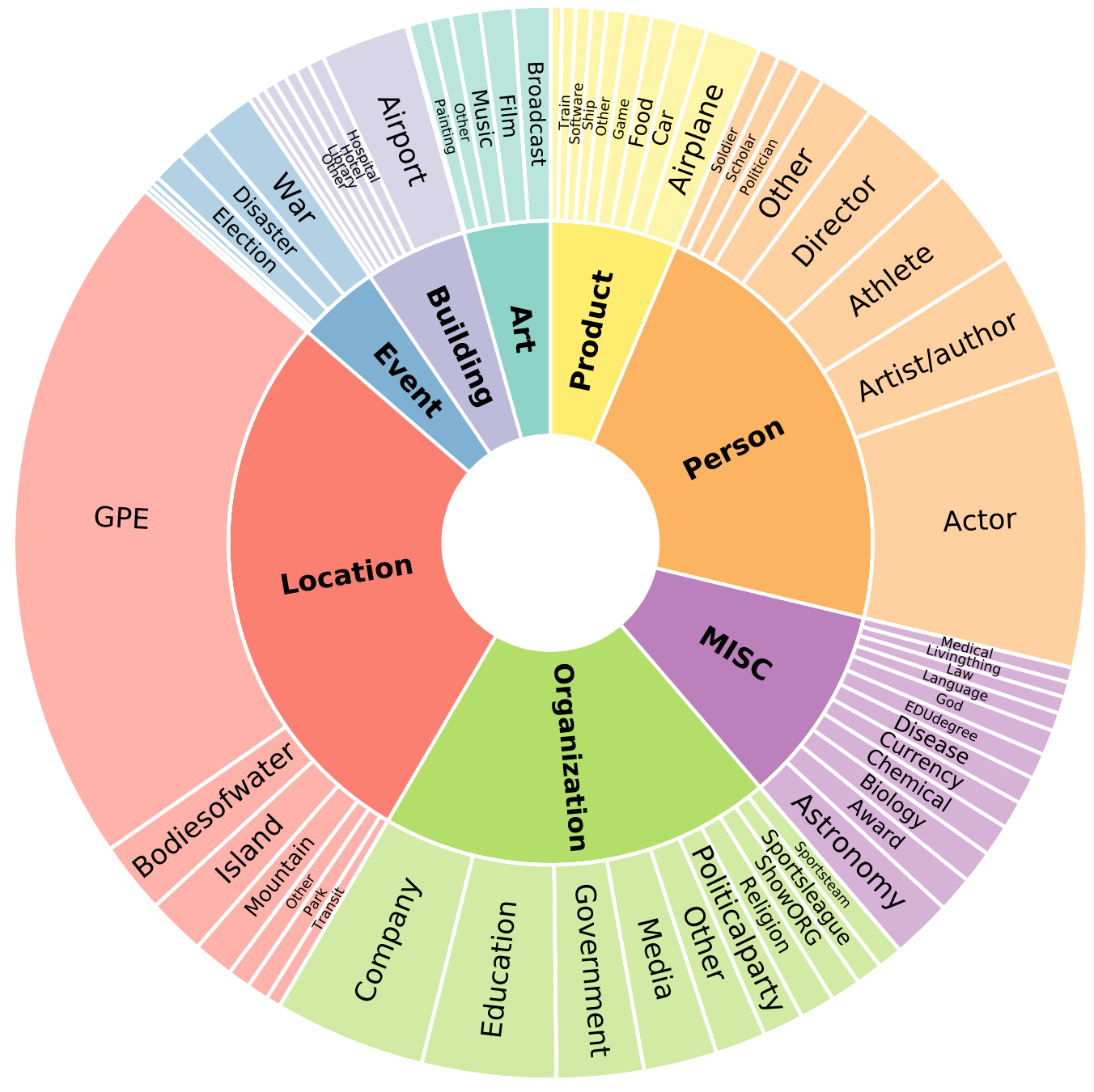
Few-NERD is manually annotated based on the context, for example, in the sentence "London is the fifth album by the British rock band…", the named entity London is labeled as Art-Music.
Run the following script to install the remaining dependencies,
pip install -r requirements.txt- Few-NERD contains 8 coarse-grained types, 66 fine-grained types, 188,200 sentences, 491,711 entities and 4,601,223 tokens.
- We have splitted the data into 3 training mode. One for supervised setting-
supervised, the other two for few-shot settinginterandintra. Each contains three filestrain.txt,dev.txt,test.txt.superviseddatasets are randomly split.interdatasets are randomly split within coarse type, i.e. each file contains all 8 coarse types but different fine-grained types.intradatasets are randomly split by coarse type. - The splitted dataset can be downloaded automatically once you run the model. If you want to download the data manually, run data/download.sh, remember to add parameter supervised/inter/intra to indicate the type of the dataset
To obtain the three benchmark datasets of Few-NERD, simply run the bash file data/download.sh with parameter supervised/inter/intra as below
bash data/download.sh supervisedTo get the data sampled by episode, run
bash data/download.sh episode-data
unzip -d data/ data/episode-data.zipThe data are pre-processed into the typical NER data forms as below (token\tlabel).
Between	O
1789	O
and	O
1793	O
he	O
sat	O
on	O
a	O
committee	O
reviewing	O
the	O
administrative	MISC-law
constitution	MISC-law
of	MISC-law
Galicia	MISC-law
to	O
little	O
effect	O
. OThe structure of our project is:
--util
| -- framework.py
| -- data_loader.py
| -- viterbi.py             # viterbi decoder for structshot only
| -- word_encoder
| -- fewshotsampler.py

-- proto.py                 # prototypical model
-- nnshot.py                # nnshot model

-- train_demo.py # main training scriptAs established in our paper, we design an N way K~2K shot sampling strategy in our work , the implementation is sat util/fewshotsampler.py.
Prototypical nets with BERT is implemented in model/proto.py.
NNShot with BERT is implemented in model/nnshot.py.
StructShot is realized by adding an extra viterbi decoder in util/framework.py.
Note that the backbone BERT encoder we used for structshot model is not pre-trained with NER task
Run train_demo.py. The arguments are presented below. The default parameters are for proto model on intermode dataset.
-- mode                 training mode, must be inter, intra, or supervised
-- trainN               N in train
-- N                    N in val and test
-- K                    K shot
-- Q                    Num of query per class
-- batch_size           batch size
-- train_iter           num of iters in training
-- val_iter             num of iters in validation
-- test_iter            num of iters in testing
-- val_step             val after training how many iters
-- model                model name, must be proto, nnshot or structshot
-- max_length           max length of tokenized sentence
-- lr                   learning rate
-- weight_decay         weight decay
-- grad_iter            accumulate gradient every x iterations
-- load_ckpt            path to load model
-- save_ckpt            path to save model
-- fp16                 use nvidia apex fp16
-- only_test            no training process, only test
-- ckpt_name            checkpoint name
-- seed                 random seed
-- pretrain_ckpt        bert pre-trained checkpoint
-- dot                  use dot instead of L2 distance in distance calculation
-- use_sgd_for_bert     use SGD instead of AdamW for BERT.
# only for structshot
-- tau StructShot parameter to re-normalizes the transition probabilities-
For hyperparameter
--tauin structshot, we use0.32in 1-shot setting,0.318for 5-way-5-shot setting, and0.434for 10-way-5-shot setting. -
Take
structshotmodel oninterdataset for example, the expriments can be run as follows.
5-way-1~5-shot
python3 train_demo.py  --mode inter \
--lr 1e-4 --batch_size 8 --trainN 5 --N 5 --K 1 --Q 1 \
--train_iter 10000 --val_iter 500 --test_iter 5000 --val_step 1000 \
--max_length 64 --model structshot --tau 0.32
5-way-5~10-shot
python3 train_demo.py  --mode inter \
--lr 1e-4 --batch_size 1 --trainN 5 --N 5 --K 5 --Q 5 \
--train_iter 10000 --val_iter 500 --test_iter 5000 --val_step 1000 \
--max_length 32 --model structshot --tau 0.318
10-way-1~5-shot
python3 train_demo.py  --mode inter \
--lr 1e-4 --batch_size 4 --trainN 10 --N 10 --K 1 --Q 1 \
--train_iter 10000 --val_iter 500 --test_iter 5000 --val_step 1000 \
--max_length 64 --model structshot --tau 0.32
10-way-5~10-shot
python3 train_demo.py  --mode inter \
--lr 1e-4 --batch_size 1 --trainN 10 --N 10 --K 5 --Q 1 \
--train_iter 10000 --val_iter 500 --test_iter 5000 --val_step 1000 \
--max_length 32 --model structshot --tau 0.434If you use Few-NERD in your work, please cite our paper:
@inproceedings{ding-etal-2021-nerd,
    title = "Few-{NERD}: A Few-shot Named Entity Recognition Dataset",
    author = "Ding, Ning  and
      Xu, Guangwei  and
      Chen, Yulin  and
      Wang, Xiaobin  and
      Han, Xu  and
      Xie, Pengjun  and
      Zheng, Haitao  and
      Liu, Zhiyuan",
    booktitle = "Proceedings of the 59th Annual Meeting of the Association for Computational Linguistics and the 11th International Joint Conference on Natural Language Processing (Volume 1: Long Papers)",
    month = aug,
    year = "2021",
    address = "Online",
    publisher = "Association for Computational Linguistics",
    url = "https://aclanthology.org/2021.acl-long.248",
    doi = "10.18653/v1/2021.acl-long.248",
    pages = "3198--3213",
}Few-NERD dataset is distributed under the CC BY-SA 4.0 license. The code is distributed under the Apache 2.0 license.
If you have any questions, feel free to contact